

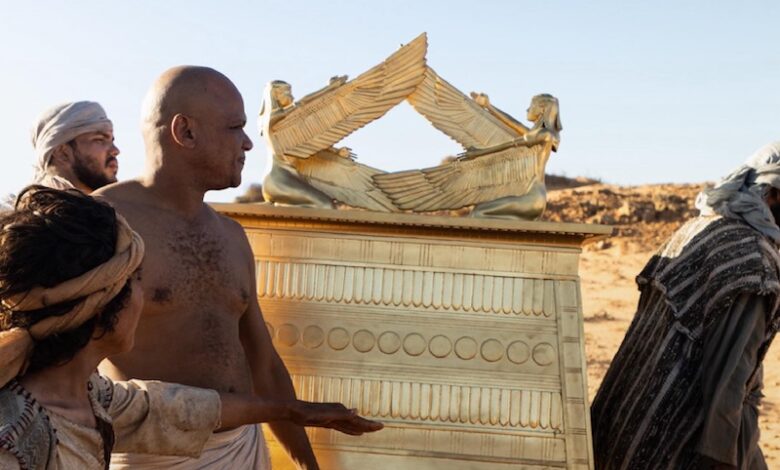
Although “The Raiders of the Lost Ark” is an entertaining movie, the real-life story of the biblical ark of the covenant is even more fascinating. A new theatrical movie, “Legends of the Lost Ark,” will be shown in theaters on April 12-15.
Archaeologist Chris McKinny, drawing on the latest research, investigates three ancient traditions that attempt to explain the artifact’s fate. He is an associate professor of archaeology at Lipscomb University, as well as a host on the Biblical World podcast. He previously served on staff at Israel’s Tell es-Safi/Gath Archaeological Project and Tel Burna Archaeological Project.
“I am a hopeless addict of the biblical world of archaeology in general,” McKinny says. “It’s fascinating to study the real landscapes, the real material culture to smell destruction layers and just be a part of that framework of really recovering the world that the biblical text was written in.”
Although archaeologists have uncovered priceless treasures from biblical times, the ark of the covenant has remained elusive. “What are the ancient sources saying about it? Because they’re far closer to that event than we are,” says McKinny. “It’s the beating heart of Israel’s story.”
The Ark continues to grab the imagination of people around the world. “It is an ancient, biblical artifact that is easy for people to visualize,” Kevin McGeough, Professor of Archaeology, University of Lethbridge, told The Ancient Near East Today magazine.
The Old Testament describes it as a sacred gold-covered chest that held the stone tablets of the Ten Commandments and symbolized the presence of God among the people of Israel.
“Solomon brings the Ark into the temple,” McKinny says. This happens in about 960 B.C., and if you follow Spielberg and Lucas, that’s where their story takes off.”
Clues in the biblical text suggest it remained in the temple, especially in the days of Isaiah and the King Hezekiah.
“Hezekiah himself prays toward Yahweh, who is enthroned above the cherubim, the text says, which clearly is an allusion to the ark when he’s invaded by Sennacherib of Assyria,” McKinny said. “That dates in 701 B.C., and so all the indications are that the ark was in the temple for the majority of its history, from about 960 to 586 B.C.”
The Babylonians conquered Jerusalem in 586 B.C., destroying the temple and taking the Israelites into captivity. The biblical text does not clearly reveal what happened to the ark. “Is it plundered? Is it destroyed? Is it secretly hidden?” he asked. “And the legends come up with these solutions as to where it might be.”
For McKinny, the Ark sits at the center of Israel’s story. “It’s the fundamental piece of Israel’s existence, the law, God’s presence among them,” he said. “I mean, if we’re not interested in it, we’re not interested in the Bible.”
For more information, visit www.legendsofthelostark.com.
–Alan Goforth
#ArkOfTheCovenant #BiblicalArchaeology #ChristianFilm #BibleHistory #LostArk #FaithAndHistory #ArchaeologyDiscovery #IndianaJones #BiblicalTruth #AncientMysteries