
Wildfire Reveals Details of Galilee Home Town of Peter, Andrew and Philip
A wildfire near the Sea of Galilee last summer is leading to a surprising result for archaeologists.
“We looked across the lake and saw there was a fire here,” Steven Notley, Ph.D., dean of the School of Religious Studies at Pillar College in New Jersey. “So, my wife and I got in the car and drove around here and saw the eucalyptus trees here at El-Araj going up in flames, and, oh, my goodness, you know – this is going to upend all of our excavation.”
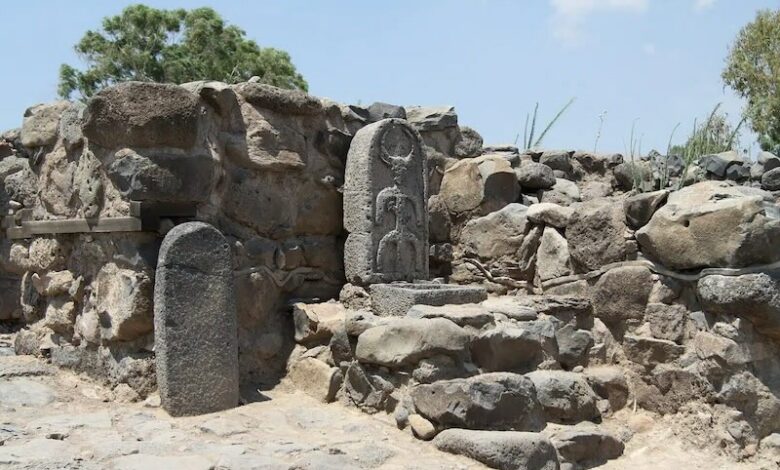
Although the fire threatened the biblical town of Bethsaida, it also proved to be revealing. CBN reports the blaze burned away thick vegetation across the Betiha reserve, exposing mounded remains and stretches of stonework that had long been hidden; what had been impenetrable brush became an accidental survey grid, allowing archaeologists to map walls and building outlines from the air and on the ground.
“After the fire was down and we walked in the burned area, we found the remains of Bethsaida Julius, the remains of walls on the surface with some stones that probably came from public buildings,” said Professor Motti Aviam, Ph.D., of Kinneret College of the Galilee told Haaretz. “We also know that it is from the Roman period, that everything from the surface is from the Roman period.”
READ: Oldest known nursing home found in Galilee
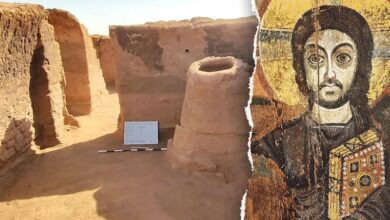
The finds add to a running case that the site known today as el-Araj is the biblically attested Bethsaida (later Bethsaida-Julias) – the fishing village named in the Gospels as the birthplace of Peter, Andrew and Philip and the scene of miracles such as the feeding of the 5,000. Among the most evocative discoveries is a Byzantine basilica, with a sixth-century mosaic that contains an inscription honoring Peter as “the chief of the apostles” and invoking him as “keeper of the key(s) to heaven,” wording that scholars say is rare in the eastern Mediterranean and that strengthens the association between the site and traditions about Peter according to the Biblical Archaeology Society.
Bethsaida now has become one of the most significant New Testament finds in the Holy Land, and the mosaic has been described by the excavation team as a uniquely explicit piece of Christian memory tying the site to the apostle Peter. “Every description is interesting and important,” Aviam said. “There is no other inscription in the eastern Mediterranean that is mentioned as the ‘Keeper of the Keys.'”
For Notley, who first argued that el-Araj – not the nearby mound of Et-Tell – fits the Gospel descriptions, the discovery affirms scriptural claims and his years of fieldwork. “I’m a person of deep faith,” he said. “…when I encounter these things, it reinforces for me the reality of my faith.” Notley’s position, and the el-Araj identification, have backers and critics: some archaeologists continue to favor Et-Tell as Bethsaida on topographical and ceramic arguments, so while the new mosaics and exposed walls add weight to the el-Araj case they have not ended the academic debate.
The wildfire that so alarmed local residents therefore had an ironic payoff for scholars: scorched earth that revealed stone. The season that followed the fire saw teams retrenching and documenting surface features, continuing earlier seasons of excavation and conservation – work that the project web site describes as aimed at understanding the village’s Roman and Byzantine phases and its role in early Christian memory. The field team stresses careful publication and peer review in the months ahead; if the inscription and basilica are confirmed in full scholarly detail they will deepen our understanding of how communities around the Sea of Galilee commemorated apostles and events recorded in the Gospels.
–Dwight Widaman