

Aerobics Pioneer Dr. Kenneth Cooper Thrives at 94
Health is "my hope and prayer for all the people."

Dr. Kenneth Cooper, who launched the aerobics exercise revolution in the 1970s, is still going strong at age 94. “I praise the Lord every day,” he says. “I give him credit for everything I’ve achieved.”
God gave him the inspiration for aerobics when he was a young Air Force doctor, Cooper said. “I frequently use the word ‘aerobics,’ which literally means ‘with air,’ or ‘with oxygen,’” he said.
The exercise program he started has been shown to help prevent numerous medical issues, including heart disease, cancer and Alzheimer’s, as well as mental health issues such as depression and anxiety. Aerobic exercise is any activity that causes the heart rate to increase, providing much-needed oxygen to cells. Doctors recommend at least two-and-a-half hours of aerobic exercise a week.
“I want to prove to the public, and this has been controversial, that exercise is medicine. We have been doing research here for over 54 years, proving exercise is medicine. This has the potential to change how medicine is done around the world,” Cooper told NBC5. “Your health is your responsibility. Keep that in mind. And no drug can replicate the benefits of an active lifestyle.”
Speaking of getting healthy, he says “that’s my hope and prayer for all the people.”
Benefits of aerobics
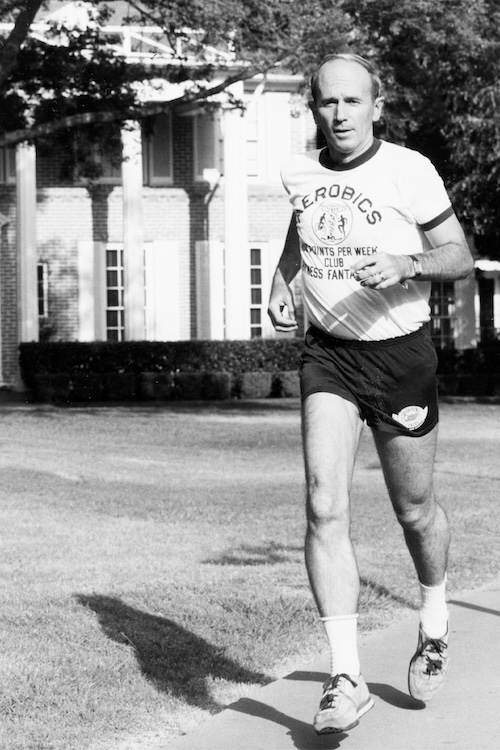
Courtesy Cooper
Cooper spent years researching the benefits of aerobics and in 1968 released his seminal work, “Aerobics,” which challenged the views of the mainstream medical community. Back then, many doctors believed aerobic exercise would lead to an enlarged heart and early death. He spent years pushing back on those claims, and in spite of the resistance, in time, aerobics became a cornerstone of good health. Cooper went on to consult NASA astronauts and Olympic athletes.
“You need to get 30 minutes of exercise, collective or sustained, most days of the week. That’s the most important thing we recommend about getting cooperized. My goal in writing this book is to get the world cooperized. Because I know, we can change your health, your longevity, the quality of life,” Cooper states.
He still exercises 30 minutes a day and works 40 hours a week at Cooper Clinic in Dallas, which helps patients live about 10 years longer than the national average. “If I die tomorrow, I’ve had a wonderful life,” he said. “I know where I’m going. I’d have no regret. The Lord has had His hand on my life. That’s the reason I’m here today.”
–Dwight Widaman