
AI Struggles With Accuracy in Quoting Scripture
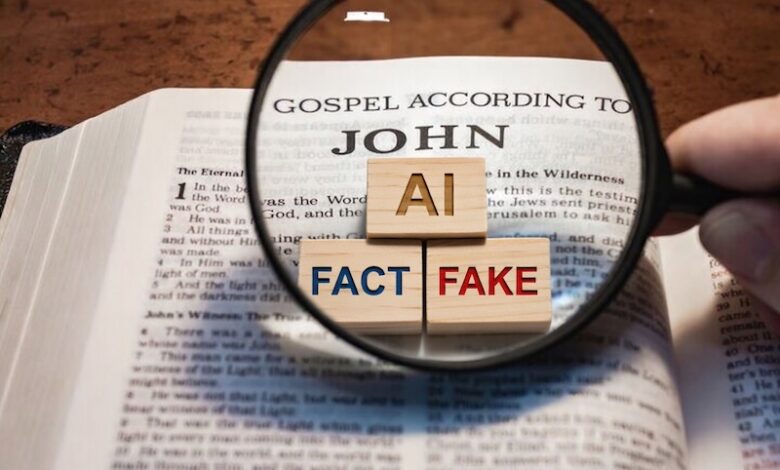
Although artificial intelligence holds great promise for unlocking scripture, Christians should be cautious at this point in its development. “If we ever do [fully adapt AI], it will be because we feel very confident that it can be done safely and be done with a level of accuracy and integrity,” Bobby Gruenewald, founder and CEO of the YouVersion app says.
YouVersion offers scripture in hundreds of languages and has become one of the most widely used Bible tools globally. Although it already uses AI internally to accelerate coding and improve workflow behind the scenes, the organization has chosen not to launch a public-facing chatbot that answers theological questions. The reason, he said, is accuracy.
Accuracy and Scripture
“The best model with the best performance, with the most popular versions of the Bible that are most indexed, misquotes scripture at least 15 percent of the time,” Gruenewald said. “Some of them as much as 60 percent of the time.”
Some chatbots not only badly paraphrase scripture, but also invent it. One of the strangest examples is that reported by Jeremy Hodes of Evangelical Missions Quarterly. Hodes’ experiment found that ChatGPT, when queried about truth, invented a scripture and labeled it John 5:5. “We know that we shall behold a Mocker of Defamers; and, as the defamers, we are of the mockers.” The actual John 5:5, of course, is about a man at the Pool of Bethesda who was ill for 38 years, whom Jesus then healed.
READ: YouVersion app empowers autistic child to communicate
Another fabricated verse, reported by Fox News, is one attributed to Jesus saying, “there is no man or woman.”
Although some errors may involve punctuation or minor wording shifts, even small changes matter. “For Bible translation, every word and punctuation is meaningful to scripture translation,” he told Christian Daily International.
Gruenewald’s caution reflects a broader debate unfolding across the Christian world. Some Christian leaders and scholars have warned that AI tools can present flawed or biased interpretations of scripture. A 2023 study explored how AI systems can produce confident yet inaccurate theological explanations and urged discernment when using such tools for Bible study. Chatbots can blend correct citations with subtle interpretive errors, creating an illusion of authority.
At the same time, churches are experimenting. Congregations have begun using AI to help draft sermons, create devotional materials and power prayer apps. Some platforms allow users to “chat” with biblical characters or ask questions about faith. Although some pastors see these tools as innovative outreach methods, others question whether they risk trivializing sacred texts or outsourcing spiritual formation to algorithms. Gruenewald draws a line at spiritual authority.
“When it comes to answering life’s most important questions and trying to give direction from God’s word,” he said, “we need it to be better in order to rely on it.”
–Alan Goforth