
Dead Sea Scrolls: The Exhibition Coming to Museum of the Bible

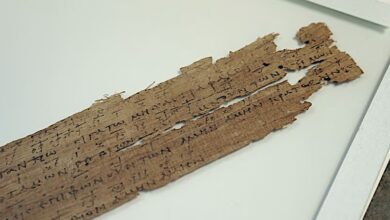
The Dead Sea scrolls, which were hidden in a cave for millennia, will be on display at the Museum of the Bible in Washington, beginning next month and continuing through much of 2026. Dead Sea Scrolls: The Exhibition, presented in partnership with the Israel Antiquities Authority, will feature scroll fragments found in the caves of Qumran, as well as hundreds of artifacts that reveal details about life and Judaism during the Second Temple period.
“The exhibition provides an extraordinary window into the life and faith of ancient Israel, Jewish faith practices and the early Christian church,” said Carlos Campo, Ph.D., CEO of the museum. “Visitors will have a once-in-a-lifetime opportunity to explore scroll fragments and historic artifacts that prove the integrity of scripture over centuries.”
The exhibition will feature three rotations of scroll fragments:
- November 2025 to February 2026: Genesis, Job, Psalms, Astronomical Enoch, Barkhi Nafshi, War Scroll, Eschatological Commentary and the Temple Scroll.
- February to May 2026: Great Psalms Scroll, Numbers, Lamentations, Community Rule, Apocryphal Psalms, Purities, Non-Canonical Psalms and the Book of the Giants.
- May to September 2026: Isaiah, Tobit, Phylacteries, Birth of Noah, Jubilees, Communal Ceremony, Community Rule and the Damascus Document.
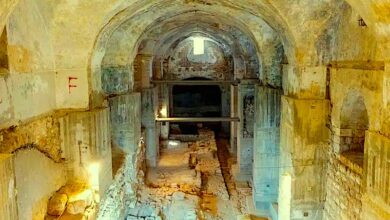
Other principal items in the exhibition include the Magdala Stone, which was discovered in 2009 at a first-century synagogue from the time and place where Jesus ministered in the region of Galilee (Mark 1:39). Another piece of history featured in the exhibition is wood fragments from a first-century CE fishing boat (also referred to as “the Jesus Boat”) uncovered in the Sea of Galilee during a drought in 1986, giving insight into how boats mentioned in the New Testament may have looked.
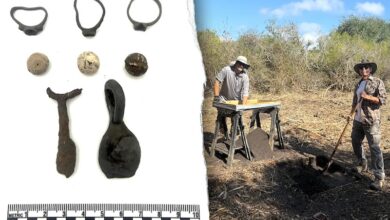
The immersive exhibition will contain more than 200 artifacts from Israel’s National Treasures of the Israel Antiquities Authority.
Recently, researchers using artificial intelligence and new radiocarbon dating methods have found that the Dead Sea Scrolls are older than previously thought.
“The implications are profound,” Maruf Dhali, assistant professor of AI at Groningen in the Netherlands and coauthor of the study, told “All Israel News.” “With empirical evidence now anchoring paleographic analysis, scholars can revisit longstanding questions about when particular biblical texts circulated and how these scripts relate to political and cultural shifts in ancient Judea.”
Experts previously based their estimates primarily on the changes observed in text as the Hebrew script evolved over time, together with some limited carbon dating, leading to a broad scholarly consensus.
“The discovery of the Dead Sea Scrolls moved back the oldest biblical references over 1,000 years,” said Orit Shamir, Ph.D., from the Israel Antiquities Authority. “They have revolutionized biblical scholarship by providing a glimpse into how the Bible was understood and practiced centuries before the common era.””
–Dwight Widaman