
Historic Route 66 Church Preserves Region’s Faith Heritage
As America celebrates its 250th anniversary this year, another milestone is drawing travelers to one of the nation’s most beloved highways. Historic Route 66, officially designated in 1926 during a meeting in Springfield, Mo., is marking its 100th birthday. Big and small towns alike across the eight-state journey are celebrating the road’s history and the people and places that helped make it an enduring symbol of America.
Just west of Springfield, one of those stories began long before the Mother Road.
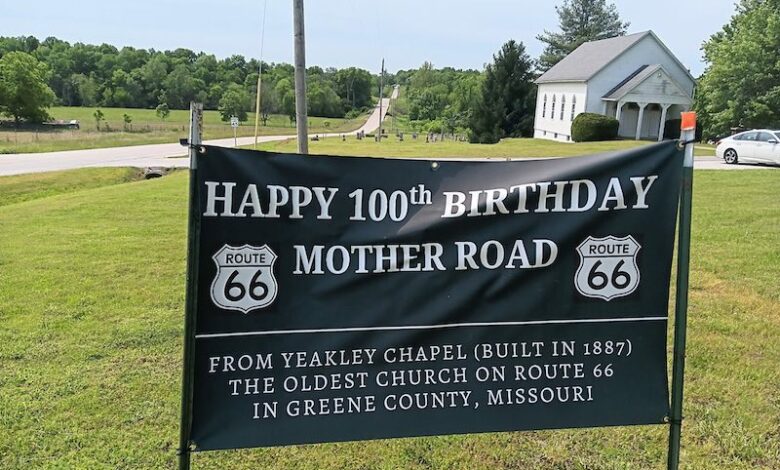
Yeakley Chapel, an iconic-looking white Methodist church along the old Route 66 alignment near Halltown, has welcomed worshippers since the Civil War era. Long before motorists began crossing America in search of a new life, frontier families gathered there for prayer, hymns and potlucks.
For modern Route 66 travelers, the little country church is just a tourist stop, beside the a highway made famous more recently in the animated Pixar film “Cars.”
But the history goes back more than 150 years for the church. It was already old when Route 66 was given its famous name in Springfield in 1926. The Christian Science Monitor stated that the church, founded in 1865 and rebuilt in 1887, “belongs to an older America of wagon roads, frontier settlements and rural congregations that gathered long before automobiles began carrying tourists west.
“America is filled with places like this: small churches and volunteer fire departments, grange halls and veterans posts. They survive not because of institutional strength but because somebody quietly decides they are worth caring for.”
 The National Park Service notes that Route 66 connected Chicago and Los Angeles and eventually stretched roughly 2,400 miles. It became an enduring symbol of freedom, mobility and the American road trip. Today, hundreds of historic buildings, bridges and cultural landmarks remain along its path.
As Metro Voice reported in April, Springfield played a pivotal role in the highway’s birth. On April 30, 1926, an official telegram sent from Springfield’s Colonial Hotel accepted the now-famous designation of “Route 66” for the new transcontinental highway. Springfield attorney John Woodruff and Oklahoma highway commissioner Cyrus Avery had championed the route connecting Chicago and Santa Monica, Calif., helping create what would become one of the world’s most recognizable highways.
The centennial is being celebrated across Missouri with museum exhibits, festivals and community events honoring the Mother Road’s legacy. As Metro Voice previously reported, the State Historical Society of Missouri opened its “Through the Windshield: Missouri’s Route 66” exhibition, while Springfield hosted the National Route 66 Centennial Kickoff, drawing historians, preservationists and travelers from around the country.
Yeakley Chapel represents a different kind of landmark.
The Yeakley family came from Greene County, Tenn., arriving in Missouri around 1840 as part of the westward movement of Methodist settlers. John Yeakley organized the congregation in 1865, the same year the Civil War ended. He and five other families built the first church.
That building was destroyed by fire on Jan. 29, 1883. Four years later, the congregation built the chapel that still stands today. John’s son, Thomas, donated the land that now holds the chapel and its cemetery.
“They came here in a wagon, not in a convertible on primetime television,” John Schmalzbauer, a historian and the congregation’s pianist, told the “Christian Science Monitor.”
Pastor Susan Schmalzbauer hopes visitors who stop to photograph the picturesque church will discover something more meaningful than an old building.
“We want to have a sign ministry on Route 66,” she said. “Because we already know people like to stop and take pictures. So we’re going to give them a little message when they stop too. I want them to know that we’re still worshipping here on the route, and we were here before it was the route.”
Attendance remains small. On a recent Sunday, only eight people gathered for worship, including one guest. Yet Schmalzbauer believes size is not the measure of a church’s significance.
“I think one of the things that people are failing to honor is small things,” she said. “Small things that look small can be a very big thing to people.”
She said the church’s responsibility remains the same regardless of how many people fill the pews.
“It’s the church’s responsibility to take care of everyone who is in here,” she said.
As thousands of travelers drive Missouri’s stretch of Route 66 during its centennial year, Yeakley Chapel offers a reminder that some of America’s most enduring stories are not found in neon signs or roadside attractions. They are found in faithful congregations that have quietly served their communities for generations, preserving a heritage that began decades before America’s most famous highway ever passed their front door.
–Dwight Widaman
#Route66 #Missouri #MethodistChurch #SpringfieldMO #ChurchHistory #America250 #Route66Centennial #FaithHeritage