

China Remains No. 1 Source of Counterfeit Products
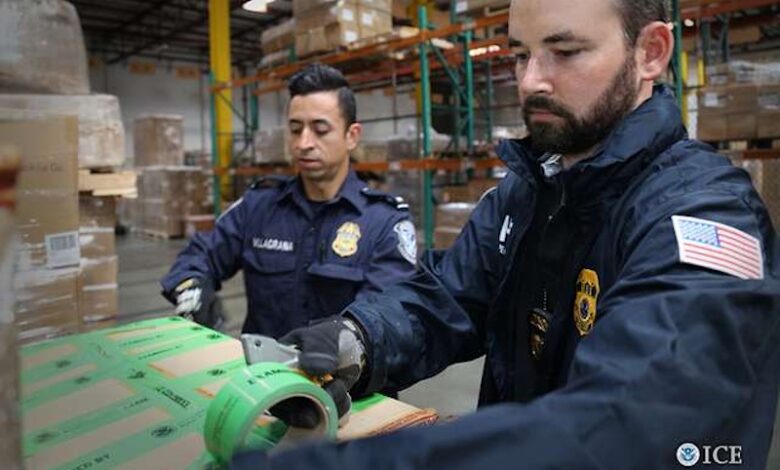
China is by far the top source of fake products worldwide, the Office of the U.S. Trade Representative (USTR) said in a March 3 statement on its yearly Notorious Markets List for 2025.
The 2025 Review of Notorious Markets for Counterfeiting and Piracy report highlights 37 online markets and 32 physical markets across various nations that are “reported to engage in or facilitate substantial trademark counterfeiting or copyright piracy,” according to USTR.
Out of the 19 nations identified as hosting physical markets, China “continues to be the number one source of counterfeit products in the world,” the report said.

China was also in the top spot in the 2024 list.
“IP-infringing goods from China, including Hong Kong, seized by U.S. Customs and Border Protection in Fiscal Year 2024 accounted for almost 93 percent of the value of all IP-infringing goods seized from all countries, as measured by manufacturers’ suggested retail price,” the report said.
“Counterfeiting activities have increased as economic conditions have declined within China. Although foot traffic to some physical markets has declined, sellers of counterfeit merchandise continue to use their brick-and-mortar storefronts as points of contact for customers, sites for ‘sample/product testing,’ and centers for fulfillment of online sales.”
The report listed five markets of concern in China that sell counterfeit goods—Baiyun Leather Trading Center, Huaqiangbei Electronics Malls, and Luohu Commercial City, all three in Guangdong Province, plus Kinsun Market in Guangzhou and Wu’ai Market in Liaoning Province.
India and Mexico were other major nations of concern, along with Argentina, Peru, Russia, Turkey, Vietnam, Brazil, Cambodia, Canada, Colombia, Indonesia, the Kyrgyz Republic, Malaysia, Paraguay, the Philippines, Thailand, and the United Arab Emirates.
Several shipments of counterfeit goods from China have been interdicted by U.S. authorities over the past year. On Jan. 29, U.S. customs officials seized more than $300,000 in fake products from China, including knockoff versions of Chanel and Louis Vuitton.
In November 2025, Customs and Border Protection said it had seized a shipment of counterfeit toys from China in Norfolk, Virginia, worth more than $775,000. In June, Louisville customs officials said they took into custody 2,193 pieces of counterfeit jewelry originating from China and Hong Kong.
Online Markets, Sports Broadcast Piracy
The Notorious Markets List report mentioned several online websites facilitating piracy of digital content, including movies, TV shows, games, ebooks, and software.
Some of the digital services pirating copyrighted content and listed as top concerns in the report were 1337X, Cuevana, GenIPTV, HiAnime, Libgen, MagisTV, Sci-Hub, ThePirateBay, and YTS.
The report highlighted the challenges posed by “Cyberlockers,” which act as hosting and content storage sites for the world’s most popular piracy websites. Such services of concern include 1Ficher, DDoS-Guard, FlokiNET, KrakenFiles, MegaCloud, and Rapidgator.
The USTR listed several popular Chinese e-commerce websites as the platforms that facilitate the sale of counterfeit goods—DHgate, Douyin Shangcheng, Pinduoduo, and Taobao.
The report shed light on the issue of piracy of live sports broadcasts and protecting copyrights. In 2023, the NFL, NBA, and UFC claimed that live piracy cost the global sports industry up to $28 billion in additional potential annual revenues.
“With the United States co-hosting the FIFA World Cup, we are particularly attuned to sales of counterfeit merchandise and illicit streaming of sports broadcasts,” U.S. Trade Representative Jamieson Greer said.
“Not only do such activities amount to intellectual property theft, they also harm consumers, such as through purchasing substandard goods that can present health or safety concerns or downloading malware when visiting sites engaged in these activities.”
China’s theft of U.S. intellectual property fuels the Chinese
Communist Party’s (CCP’s) military and economy, according to an April 2025 commentary by former U.S. Navy Capt. Stu Cvrk published by The Epoch Times.
The CCP employs economic espionage and other mechanisms to obtain advanced tech with dual military-civilian uses, including next-gen communications, artificial intelligence, and electronic surveillance.
The CCP’s stealing of U.S. intellectual property costs Americans up to $600 billion per year, an expert testified on Capitol Hill in March 2023.
Moreover, there are concerns about the quality of counterfeit Chinese goods, with a South Korean government investigation from 2023 finding that some of these fake products exceeded carcinogen limits by 930 times, posing serious health risks.
By Naveen Athrappully | Epoch News