
Archaeologists, Students Discover Long-Lost Spanish Mission in Texas
The Alamo, which plays a major role in the history of Texas, originally was a Spanish mission. Archaeologists recently discovered another mission that helps shine new light on the spread of Christianity in the Lone Star State.
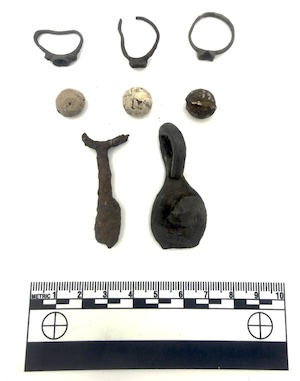
Excavators from Texas Tech University unearthed remains belonging to Mission Nuestra Señora del Espíritu Santo (Mission Our Lady of the Holy Spirit), an abandoned settlement in Jackson County, Texas, Fox News reported. With the help of students, excavators discovered proof of the missing site, which resolves “decades of searching” and “fills a long-standing gap in the historical record of early Texas,” the university said in a recent release.
According to local reporting by the Jackson County Herald-Tribune, the Texas Tech team worked alongside archaeologists from the Texas Historical Commission to locate the site on private land near the historic Presidio La Bahía and the former location of Fort St. Louis.
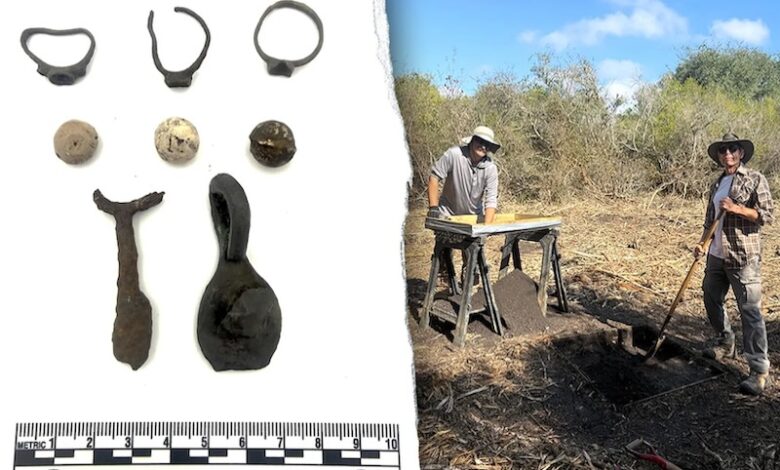
“We found lead shot and sprue, sourced to the mines in Boca de Leones in Nuevo Leon, Mexico, rose head nails — indicative of this time period — and parts of a copper kettle, including a handle,” Tamra Walter, an associate professor of archaeology at Texas Tech University, told Fox News Digital.
In addition to metal objects, researchers also recovered pottery fragments and other materials that helped confirm the site’s identity as an early 18th-century Spanish mission, according to the Fox News report.
The mission was related to Presidio La Bahía, a Spanish fort, and Fort St. Louis, a colony established by French explorer René-Robert Cavelier, Sieur de La Salle. La Salle’s settlement, which failed, prompted Spain to reassert control over the region. Historians have long noted that the collapse of the French colony intensified Spanish efforts to secure the Texas frontier.
Spain eventually settled the area as part of its missionary strategy following the demise of La Salle’s colony in the 1680s, according to Texas Tech’s official account of the excavation.
What makes the mission’s remains particularly significant is their rarity. The settlement was occupied for only a brief period in the early 1720s before being relocated. “Earlier occupations are obscured by later ones,” Walter said in an interview published on Texas Tech’s Now site. “At this mission, activity dates from about 1721 or 1722 to 1725 or 1726. We have a snapshot of what it was like to live on the Spanish frontier of Texas at that very moment.”
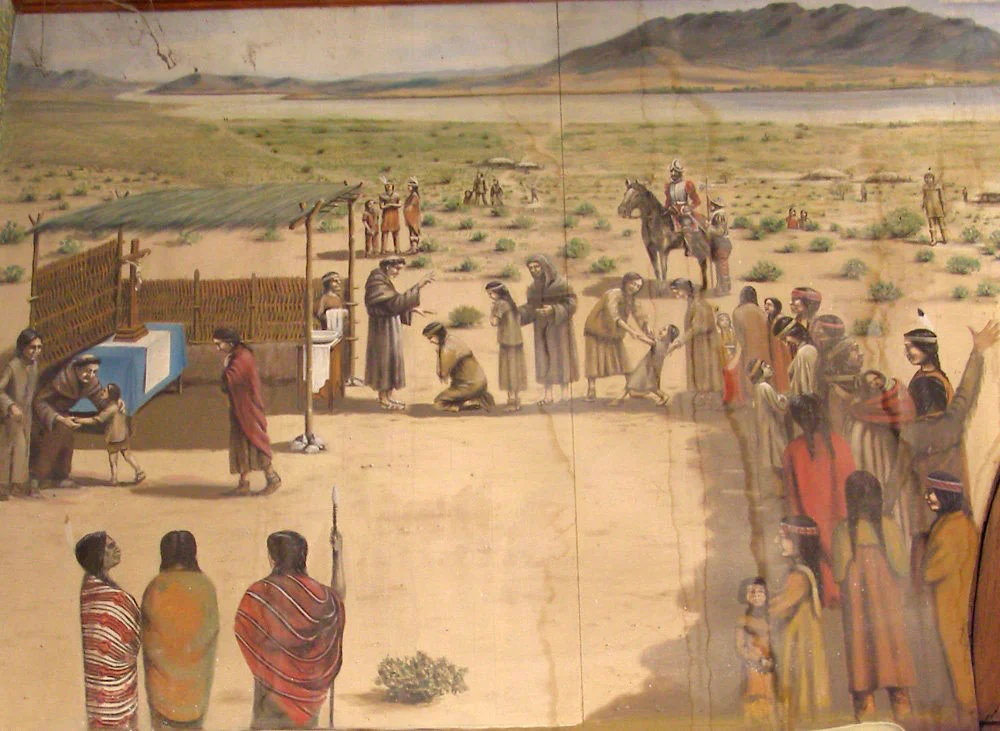
For archaeologists, the discovery resolves one of the most sought-after unanswered questions in the state. “It was definitely in the top five for archeologists to find, if not number one,” Walter said in an interview with KCBD, as reported by KTRE. “And we knocked that off the list. We found it.”
The find also clarifies the early history of Mission Espíritu Santo, which later relocated near present-day Goliad and became the better-known mission preserved today as part of Goliad State Park. That later site is documented in the Handbook of Texas Online.
Her students were excited to be part of the search for the mission. Much of the work involved hands-on excavation alongside professional archaeologists, giving students rare, first-hand experience with artifacts used more than three centuries ago, according to Fox News.
The discovery adds an important chapter to the story of early colonial competition in Texas, linking French exploration, Spanish missionary efforts, and the eventual development of the region long before it became part of the United States.
–Dwight Widaman