
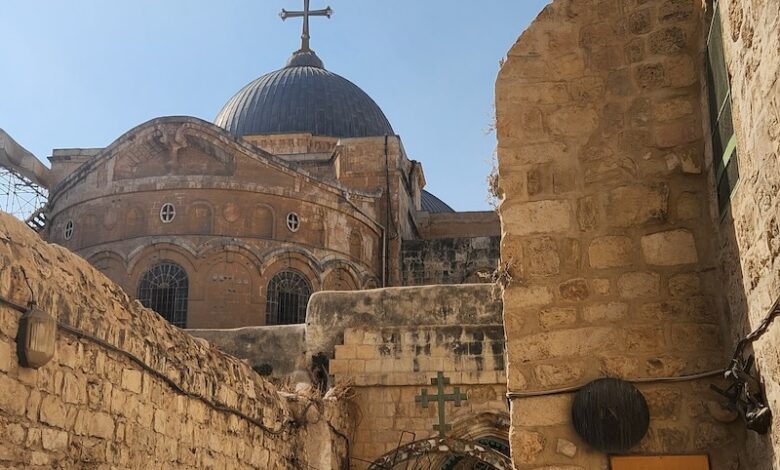
Israeli officials and Catholic Church leaders traded verbal jabs after the closing of Jerusalem’s Church of the Holy Sepulchre and other major holy sites on Palm Sunday. The closures were part of Israel’s broader wartime restrictions that have seen other large crowd venues closed because there are not enough bomb shelters.
While the Catholic Church called the police decision “a manifestly unreasonable and grossly disproportionate measure,” Israeli police cited the need to balance freedom with public safety. An Iranian missile recently landed in the church courtyard. The structure, which dates to the 4th century, has no public bomb shelters for the multiple thousands that traditionally visit it daily during Passion Week.
The Prime Minister’s Office said there had been “no malicious intent whatsoever” by the police.
Israel initially stood by its safety measures, which all Israelis live under, saying “Under Home Front Command directives, lifesaving restrictions apply to all holy sites in the Old City — for Jews, Christians and Muslims alike.” “The Old City has been targeted by murderous missiles multiple times this month, alongside constant fire on residential areas. These threats do not discriminate between religions, and neither does our duty to protect you. We are in active dialogue with religious leaders, including an upcoming meeting with the Patriarch, to examine solutions that balance freedom of worship with public safety.”
The Latin Patriarchate said Cardinal Pierbattista Pizzaballa, the Latin Patriarch of Jerusalem, and Father Francesco Ielpo, who are all typically hostile to the Israeli government, were filmed being stopped by Israeli police while trying to reach the after the traditional Palm Sunday procession had already been canceled Sunday. The religious leades were accused of fabricating the incident, having already known of the restrictions before they forced the confrontation with police.
Observers say that while the restrictions made sense in light of the daily Iranian missile barrage, inaccurate reporting and social media outrage put Israel in a corner, having to defend itself as the only nation in the Middle East where freedom of religion exists, but still needing to ensure public safety during the war.
Prime Minister Benjamin ordered an exception for the easing of safety guidelines and allowing it to open to large crowds, even as thousands of other Israeli events are canceled or scaled back, such as weddings and university lecture halls.
Israeli President Isaac Herzog then called the restricted worshipers to “express my great sorrow over this morning’s unfortunate incident.”
“I clarified that the incident stemmed from security concerns due to the continuous threat of missile attacks from the Iranian terror regime against the civilian population in Israel, following previous incidents in which Iranian missiles fell in the area of the Old City of Jerusalem in recent days,” he wrote on social media. “I reaffirmed the state of Israel’s unwavering commitment to freedom of religion for all faiths and to upholding the status quo at the holy sites of Jerusalem.”
In a joint statement issued by the Latin Patriarchate of Jerusalem and the Custody of the Holy Land, they thanked President Isaac Herzog for his intervention and stressed the need to safeguard freedom of worship during the war.
Israel is not playing favorites, Israeli news outlets report. The Western Wall, the holiest site for Jews, also remains closed to large group. Just 50 people at a time are allowed to pray in an enclosed area adjacent to the plaza.
The Holy Sepulchre, on the other hand, can host thousands inside at the same time.
–Dwight Widaman