
Ancient Date Palms Revive Biblical Prophecy in Israel
Seeds hold record as oldest to ever sprout
Date palm tree seeds found at the ancient site of Masada, dating back 2,000 years to the time of King Herod and the New Testament, have been successfully sprouted. The first seed, named Methuselah, sprouted in 2005. Although Methuselah is a male tree and cannot produce fruit, later efforts between 2007 and 2011 sprouted female trees that now have successfully produced fruit.
Researchers have said the seeds were recovered from archaeological sites in the Judean Desert and near the Dead Sea, with some dating from roughly 1,800 to 2,400 years old.
Years ago at Masada, archaeologists found a jar of those ancient date seeds. According to published research and later reports, seeds from Masada were preserved for decades after excavations in the 1960s before scientists attempted germination, making Methuselah one of the oldest known seeds ever successfully sprouted with human assistance.
“We’re talking about the resurrection of 2,000-year-old plus ancient date seeds that come from the Judean Desert and from Masada and which are part of a scientific experiment,” said Sarah Sallon, director and founder of The Natural Medicine Research Center at Hadassah Medical Organization in Jerusalem.
Sallon’s work has been carried out in cooperation with plant scientist Elaine Solowey at the Arava Institute’s Center for Sustainable Agriculture at Kibbutz Ketura in southern Israel. Their project has aimed not only to germinate ancient seeds but also to learn more about the origins, resilience and agricultural characteristics of the historic Judean date palm.
“In ancient times, the classical writers described in detail the dates of ancient Judea,” she told CBN News. “Why? Because they were famous. They were big; they were sweet. They were very dry. That allowed them to be exported all over the Roman empire, and they had medicinal qualities.”
The date palm was a key symbol for the province of Judea during Roman times. It also is a significant symbol in the Bible, representing the righteous in Psalms and appearing in Ezekiel’s prophecy regarding the future temple. In Ezekiel’s prophetic vision of the temple, palm trees are carved alongside cherubim on the walls and doors.
That symbolism also has been noted by Israeli researchers and writers who say the ancient Judean date became associated with the land’s fertility, beauty and abundance. Scientific analysis published in 2020 said the germinated seeds offer a rare window into a crop once widely known in antiquity but later lost for centuries.
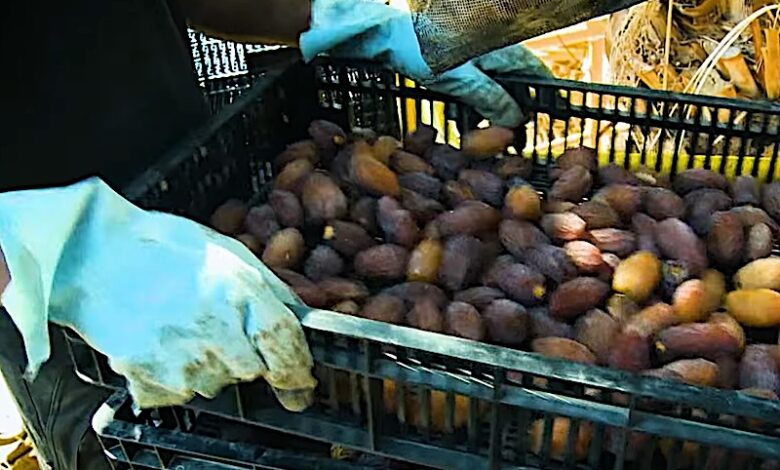
Hannah, the first female tree, was planted in 2019. Pollinated by Methuselah, Hannah had around 100 dates last year, and this year she had more than 600 dates. Reports from the Arava Institute have described that early harvest as a milestone, with researchers tasting fruit from the revived line and comparing it to modern varieties. One institute report said Hannah later produced nearly 700 dates in a single season.
JNS reported in 2020 that several revived trees were named after biblical figures, including Adam, Boaz, Hannah, Jonah, Judith and Uriel, and were grown from among 32 seeds unearthed in excavations between 1963 and 1991. The project has attracted international attention as both a scientific achievement and a cultural recovery of a plant tied closely to the biblical landscape.
Sallon, a medical doctor, started this project more than 15 years ago after becoming interested in natural medicine.
“I wanted to see how medicinal the flora of Israel was and what it had been used for and so on,” she said. “And then I realized that many of these species had actually disappeared. And we knew what there was, because it’s mentioned in the Bible. The Bible is our guidebook of ancient species.”
Researchers involved in the project have said the work also may help scientists understand how ancient crops adapted to harsh desert conditions. The Arava Institute has described the effort as a way to shed light on ancient cultivation techniques and to explore whether traits from the historic Judean date could hold relevance for present-day agriculture.
The successful revival of these trees is seen as a fulfillment of prophecies regarding the desert blooming in Isaiah 35. These passages are interpreted as referring to the Messianic age.
Dr. Tareq Abu Hamed, director of the Arava Institute at Kibbutz Ketura, sees this as a link to the past.
“If you don’t look back to the history, you will not see the future,” Hamed said. “And here we are actually planting history at the Arava Institute. We hope that one day these trees that came from 2,000 years ago will be the hope of peace in our region.”
For many Christian and Jewish readers, the revived trees carry meaning beyond botany. They connect the modern State of Israel with the agricultural world of the Bible, the Roman-era Judean landscape and enduring prophetic imagery about renewal in the desert. Researchers, meanwhile, continue to frame the work as both a scientific experiment and a recovery of an ancient part of the region’s natural heritage.
–Metro Voice and wire services
#BiblicalProphecy #Israel #DatePalms #Masada #Isaiah35 #AncientSeeds #BibleProphecy #JudeanDesert